
Cut Your Carbon Footprint for 2025 In 3 Simple Steps
With tightening regulations, rising consumer expectations, and increased scrutiny on corporate emissions, reducing your carbon footprint isn’t just about the planet—it’s about profitability, reputation, and long-term resilience.
Download the guide for three straightforward, high-impact steps enterprise food businesses can take today to future-proof operations, meet sustainability targets, and gain a competitive edge in 2025 and beyond.
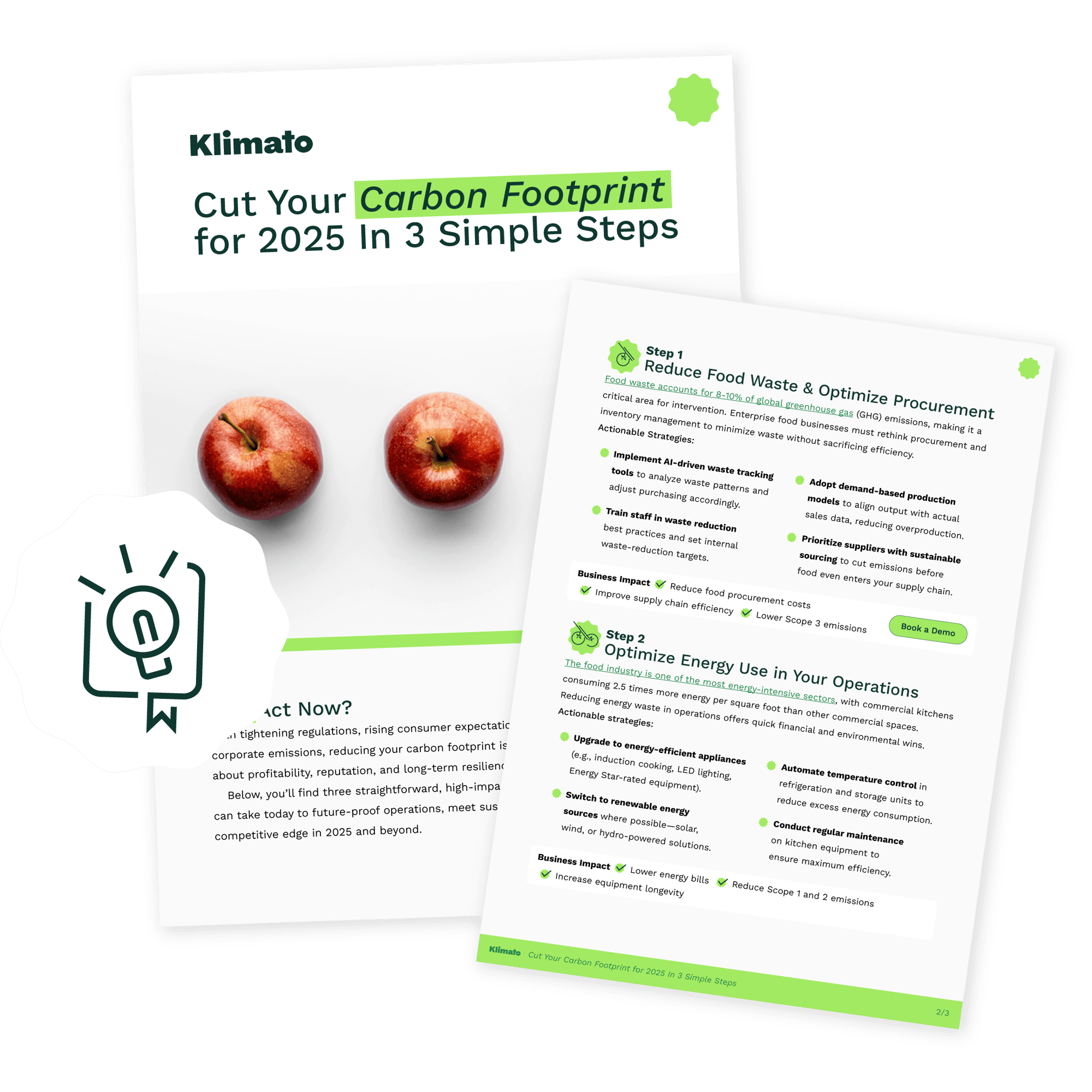
Request guide
FAQ About Cutting Your Carbon Footprint
What are the most important steps for an enterprise food business to reduce its carbon footprint?
For enterprise food businesses, the three highest-impact steps are: first, establishing an accurate emissions baseline at the ingredient and dish level; second, identifying the specific menu items and procurement categories driving the most emissions; and third, making targeted changes—ingredient substitutions, supplier shifts, or menu redesigns—and tracking progress over time. Businesses that follow this measure-identify-act cycle consistently outperform those taking a broader, less structured approach. Read a practical guide to scope 3 reporting for food businesses and explore how food businesses should stay ahead of climate regulations.
Why is reducing carbon footprint important for food business profitability?
Reducing carbon footprint in food operations directly impacts profitability because the ingredients with the highest emissions are typically the most expensive to source. Cutting emissions through smarter procurement and menu design simultaneously reduces food costs, improves margins, and strengthens the sustainability credentials that now influence corporate contracts and consumer preference. Sustainability is no longer a cost, but a margin improvement strategy. See how sustainability practices can drive profitability in food service and 5 ways to maximize ROI with climate labeling.
How do tightening climate regulations affect enterprise food businesses in 2025 and beyond?
Enterprise food businesses face a rapidly evolving regulatory landscape. CSRD now requires detailed scope 3 emissions disclosures for large companies operating in the EU, and carbon tax exposure is increasing across multiple markets. Businesses that have already established accurate food emissions measurement are significantly better positioned to comply quickly and cheaply, while those starting from scratch face higher costs and reputational risk. Assess your carbon tax exposure as a food business and find out how to future-proof your food business against ESG regulations.
What is the fastest way for a food business to establish a carbon footprint baseline?
The fastest route to a carbon baseline is connecting your existing recipe and procurement data to a food-specific emissions platform. Unlike generic carbon calculators, food-native platforms use ingredient-level LCA data to produce accurate dish-by-dish CO2e figures within weeks rather than months. This gives enterprise operations an immediate, auditable baseline to report against and act on. Understand why generic carbon calculators don't work for food and use Klimato's carbon footprint calculator for food businesses to get started.
How can food businesses reduce carbon emissions across a large or complex menu?
For enterprise operations with large menus, the key is prioritization rather than wholesale change. Emissions data typically reveals that a small number of high-carbon dishes—usually those heavy in beef, lamb, or dairy—account for a disproportionate share of total food emissions. Targeting substitutions in just these dishes can deliver significant overall reductions without disrupting the broader menu. Learn more about how AI can reduce your food business carbon footprint and from carbon data to better food decisions.