





<img height="1" width="1" style="display:none;" alt="" src="https://px.ads.linkedin.com/collect/?pid=6205948&amp;fmt=gif">
Skip to content
2026_KFE_product-feature_ report

Klimato Food Emissions

Get Clarity on Your Food Emissions and Your Scope 3 Category 1 Reporting

Food and beverage purchasing is one of the largest sources of emissions for food businesses, and one of the most difficult to measure accurately. Most tools weren't built for the complexity of food procurement; thousands of SKUs, ingredient-level variation, diverse supplier bases, and land use impact that generic carbon platforms simply don't reach.

Klimato Food Emissions is built to solve that. It maps your procurement data to granular, activity-based emission factors automatically. That includes FLAG emissions, covering the land use and agriculture impact of your food sourcing. All emission factors come from the Klimato database, built from peer-reviewed Life Cycle Assessment studies and aligned with the GHG Protocol. The result is accurate, audit-ready food emissions data, delivered back into your existing systems, with an optional procurement report available for your team and stakeholders.

Designed for Food Operators Who Need Clarity on Their Emissions

Here's what that looks like in practice—from how your data gets in, to how it comes back out.

Icons-small_lychee-lime_tomato

Automated Food Emissions Mapping

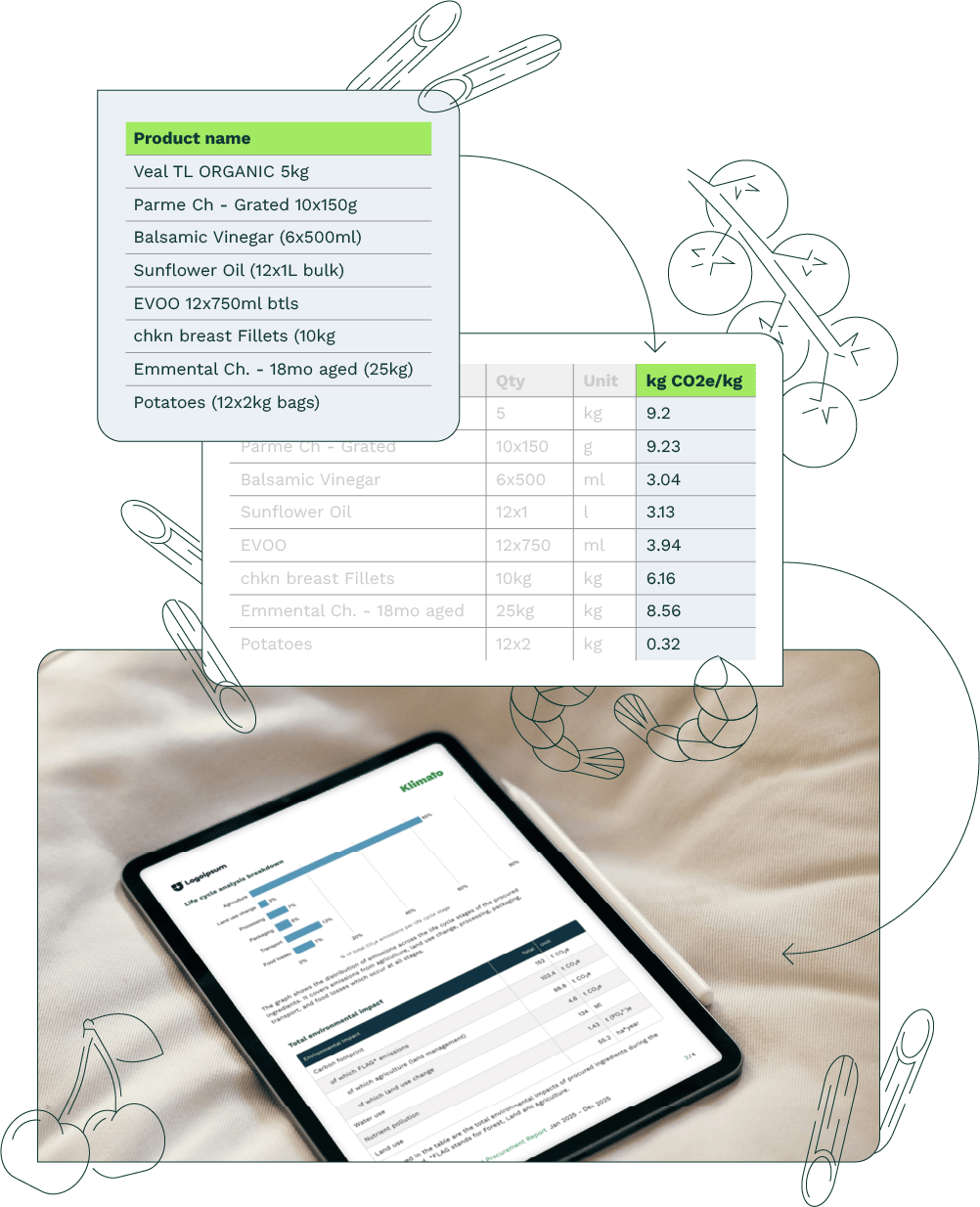
Upload procurement data or connect your purchasing system. Klimato handles SKU mapping, emissions factor application, and data cleaning—no manual spreadsheet work required.

Icons-small_lychee-lime_electricity

Activity-Based,
Not Spend-Based

Emissions are calculated at ingredient level using activity data (quantities and product types) rather than financial proxies. The result is accuracy that spend-based tools cannot match.

Icons-small_lychee-lime_packaging

CSRD-Ready
Reporting Outputs

Every figure is traceable to its methodology. Reporting outputs are structured for CSRD/ESRS E1, GHG Protocol Scope 3 Category 1, and SBTi/FLAG submissions.

Icons-small_lychee-lime_heat

Data Delivered Back Into Your Existing Systems

Enriched food emissions data feeds back into the platforms your teams already use—procurement systems, carbon accounting stacks, or reporting tools. Your team works with it where they already operate.

Icons-small_lychee-lime_key

Optional Procurement Report 

Alongside the enriched emissions data, Klimato can generate a structured procurement report with category and hotspot breakdowns, formatted for your sustainability team, stakeholders, and auditors. Available as an add-on to the core product.


Why Spend-Based Tools Fall Short for Food Businesses

Most corporate carbon accounting tools calculate food-related emissions by multiplying spend against a generic emission factor. It's fast to set up. But it hides the information that actually matters, and it misses land use and agriculture impact entirely.


Capabilities
Generalist tools
Klimato
Ingredient emissions factor by country origin
Integration capabilities
Professional emission reduction services
Certified methodology & audit-ready data
Automated data cleaning and mapping, expert-verified
Scalable to full Scope 1, 2, and 3 reporting

Legend: ✔ = Core capability △ = Available but not specialized

How It Works

From Procurement Data to Ingredient-Level Emissions Data

Klimato takes your existing procurement data, maps it to ingredient-level emission factors, and delivers the enriched output back into the systems your team already works in—whether that's your procurement platform, your carbon accounting stack, or a structured data file.

What you get is accurate, audit-ready food emissions data that makes Scope 3 Category 1 reporting possible. A procurement report is available as an add-on if you need a formatted output for your sustainability team, stakeholders, or auditors.

What You Gain

What Accurate Food Emissions Data Makes Possible

Icons-small_lychee-lime_electricity

Clarity on What Your Food Purchasing Actually Emits

Replace spend-based estimates with ingredient-level, activity-based food emissions data including FLAG coverage for land use and agriculture. The accuracy that makes reporting credible and reduction strategies specific.

Icons-small_lychee-lime_shield

Hotspot Visibility That Drives Decisions

Procurement hotspot data by category, ingredient, and supplier. The granularity that makes reduction strategies specific and credible, not just directional commitments.


Icons-small_lychee-lime_diamond

Scope 3 Category 1 Reporting Your Team Can Stand Behind

Food emissions data structured to meet CSRD, GHG Protocol, and SBTi standards, with every figure traceable to its source. Audit-ready from day one.


Icons-small_lychee-lime_key

Works Where Your Team Already Works

Enriched food emissions data flows back into your existing procurement systems, carbon accounting platforms, or reporting tools. No new workflows to manage, no parallel systems to maintain.

Aligned With the
Frameworks That Matter

Klimato Food Emissions delivers Scope 3 Category 1 reporting aligned with recognized international standards. Supported frameworks include CSRD/ESRS E1, GHG Protocol Corporate Value Chain Standard, SBTi (including FLAG targets for land-related emissions), GRI 305, and VSME.

Klimato is a GRI Software and Tool Partner, supporting organizations working toward transparent and credible sustainability reporting.


Kopia av Kopia av Kopia av Namnlös design (1)
2026_plans-mock_concept

Need full Scope 1, 2, and 3 corporate reporting, not just food procurement data?

Klimato Carbon Accounting provides structured Scope 1–3 emissions reporting across your entire operation, aligned with CSRD, GHG Protocol, SBTi, and GRI.

2026_KFE_sushi-prep_1333x1000px

Everything You Need to Move from Measurement to Action

Klimato Food Emissions comes with the support and structure to get your team reporting with confidence, without months of internal setup.

  • ✔ Automated SKU mapping and data cleaning

  • ✔ Ingredient-level Scope 3 Category 1 emissions calculation

  • ✔ Structured procurement report with category and hotspot breakdowns

  • ✔ Audit-ready outputs aligned with GHG Protocol and CSRD/ESRS E1
    ✔ Guided onboarding and data setup support
    ✔ Ongoing access to Klimato's updated food emissions database

Free Scope 3 reporting guide

Everything You Need to Know About Reporting on Scope 3 Emissions

This guide breaks down how foodservice, hospitality, and manufacturing teams can approach Scope 3 with confidence, turning scattered data into credible reporting and real progress.

What you’ll learn inside:

✓ Where Scope 3 emissions typically sit across food value chains
✓ The biggest reporting challenges, and how to avoid common data gaps
✓ Practical strategies for ingredient sourcing, packaging, logistics, and menu decisions
✓ How technology supports more accurate, audit-ready reporting
✓ Steps to move from compliance pressure to operational action

Where Should We Send Your Guide?

Testimonials

Preferred by Foodservice Leaders

Food businesses across catering, hospitality, wholesale, and food production use Klimato to simplify food emissions reporting and build credible climate strategies grounded in operational reality.

  • Clients are really impressed by our work with Klimato - especially for meetings and events - and in some cases, it helps us to win business deals. It also gives us a clear competitive advantage compared to other hotels in the city.

    Majorie Sundström

    Formerly Sales Manager at Courtyard by Marriott Stockholm

    Marjorie Sundstrom
  • The climate impact insights that Klimato provides are becoming more important by the day, and the food I can cook with their help will be dominant in the future. Sodexo as a large company can influence many people to eat better, and we must take these steps together to contribute to a better future.

    Oscar Jonasson

    Executive Chef at Restaurant Björken, Sodexo Cytiva

    oscar jonasson
  • I’m impressed by the user-friendliness of the app - it is very simple, clear, and precise. Composing new recipes is not too time-consuming, and monthly reporting is great to keep us updated on our progress.

    Petra Rörfors

    Formerly Director of Sales & Sustainability at Courtyard by Marriott

    Petra Rörfors
2026_KFE_shopping-cart_1000x1333px

Frequently Asked Questions

FAQ about Klimato Food Emissions

What is food carbon reporting?

Food carbon reporting is the process of calculating and disclosing the greenhouse gas emissions associated with food and beverage procurement. For food businesses, this typically means quantifying Scope 3 Category 1 emissions—the upstream emissions generated across a company's food supply chain, from raw material production and processing through to delivery from Tier 1 suppliers. Accurate food carbon reporting requires activity-based data (quantities and product types) mapped to ingredient-level emission factors, rather than the spend-based estimates most general carbon tools rely on.

How does Klimato Food Emissions differ from carbon accounting software?

Klimato Food Emissions is purpose-built for food and beverage procurement. Where general carbon accounting platforms calculate food-related emissions using financial spend as a proxy, Klimato maps your actual procurement data—at SKU and ingredient level—to food-specific emission factors derived from peer-reviewed Life Cycle Assessment studies. That means ingredient-level granularity, FLAG emissions coverage for land use and agriculture, and outputs that are structured for Scope 3 Category 1 reporting specifically. General carbon accounting tools typically cannot match this level of food-specific accuracy. If you need full Scope 1, 2, and 3 reporting across your entire operation, Klimato Carbon Accounting covers that.

How does Klimato handle carbon footprinting for menus and recipes?

Klimato Food Emissions focuses on food procurement data—mapping your purchased SKUs to ingredient-level emission factors for Scope 3 Category 1 reporting. Menu and recipe carbon footprinting, including carbon labeling and recipe engineering, is available through the Klimato App, which can be added as an optional module. The two products work from the same underlying emissions database, so the emission factors are consistent across procurement reporting and menu management.

What data do I need to get started?

At minimum, Klimato needs an SKU or ingredient name, an external ID (typically from your procurement system), the consumption country, and the language of your SKU data. To generate full procurement reporting including emissions quantities, you also need purchased units and total weight per unit for each SKU. Klimato handles the data cleaning, merging, and mapping—you don't need to prepare a formatted or standardized file before uploading.

Which procurement and POS systems does Klimato integrate with?

Klimato integrates with a range of procurement and POS systems. Current integration partners include Millum (the largest procurement integration, widely used across Nordic foodservice), Delegate, and KitchenCut. Where a direct integration isn't available, procurement data can be uploaded via Excel or CSV file export from your ERP or procurement system. Reach out to discuss your current setup and the best path for your organization.

Is Klimato Food Emissions compliant with CSRD?

Yes. Klimato Food Emissions generates food procurement emissions data structured for CSRD/ESRS E1 disclosure requirements, along with GHG Protocol Scope 3 Category 1 reporting and SBTi/FLAG submissions. Every figure is traceable to its methodology and derived from peer-reviewed Life Cycle Assessment data verified by IVL and WRI, giving your auditors a credible and defensible basis for reported numbers.

What emissions are included in a Klimato Food Emissions report?

Klimato Food Emissions covers the greenhouse gas emissions from food and beverage procurement, including raw material production, processing, packaging, and transport to Tier 1 suppliers. This aligns with GHG Protocol Scope 3 Category 1 reporting requirements. Transport from Tier 1 suppliers to your own facilities is excluded, as it falls under Scope 3 Category 4 (if paid by your company) or Scope 3 Category 9 (if not). FLAG emissions—covering land use and agriculture—are included, making the data compatible with SBTi FLAG target submissions.

Can Klimato Food Emissions be used as a standalone product?

Yes. Klimato Food Emissions can operate as a standalone product, delivering enriched food emissions data back into your existing procurement systems or tools without requiring the Klimato App or other modules. An optional procurement report (Klimato Food Emissions Report) is available as an add-on if you need formatted reporting output for your sustainability team, stakeholders, or auditors.

Lead with Food Emissions Excellence

Ready to Get Clarity on Your Food Emissions?