










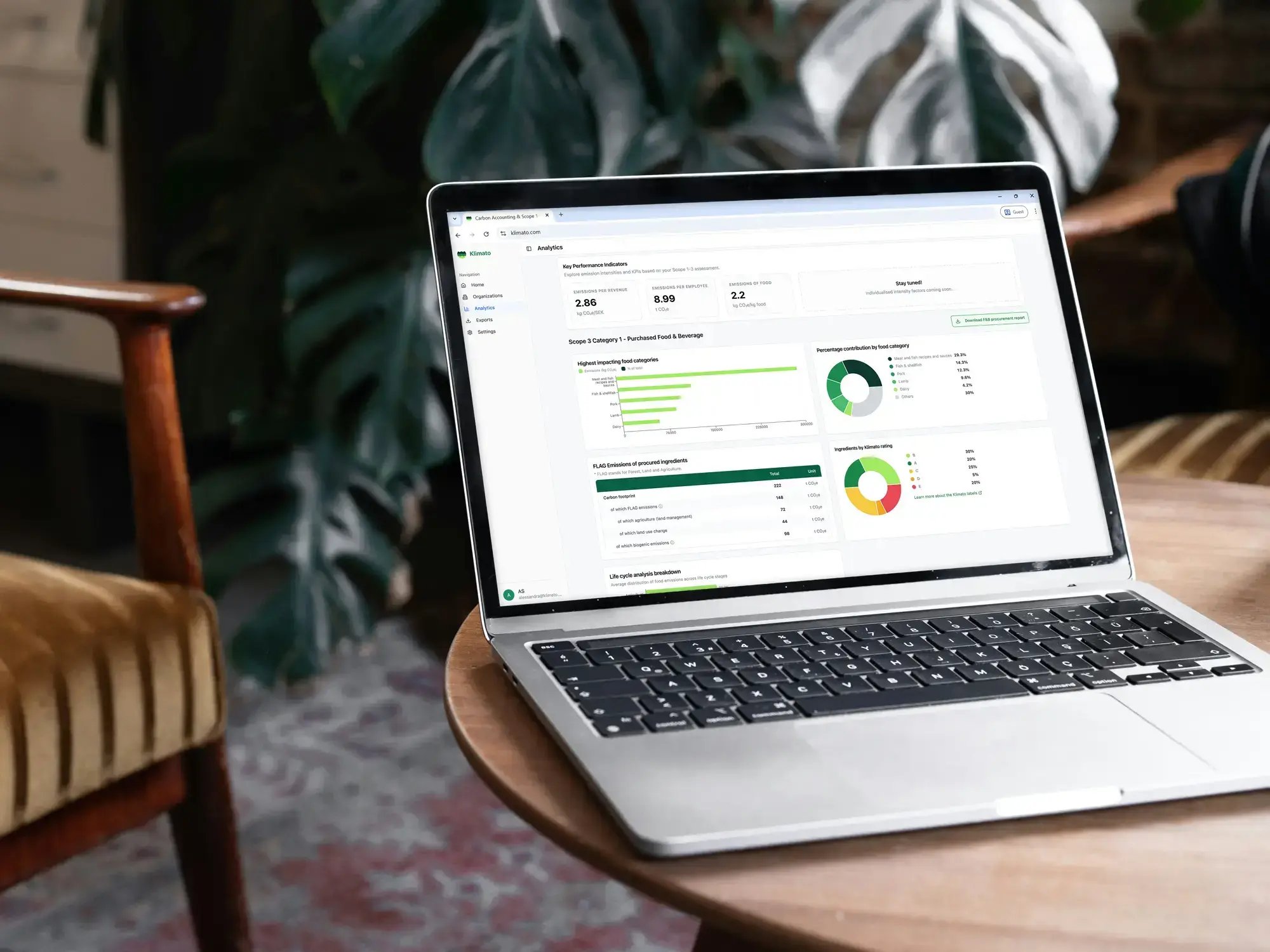
Food and Beverage Emissions Reporting for Hotels
Hotel groups face a sustainability reporting challenge that most carbon accounting tools weren't built for. Your largest source of emissions isn't your energy use or your fleet—it's in the food and beverages your properties purchase every day, across thousands of SKUs, dozens of suppliers, and multiple markets.
Regulatory pressure is accelerating. Under CSRD, food procurement emissions are almost always material for hotel groups. Corporate clients booking events and conferences are requesting verified emissions data from their venues. And hotel groups with SBTi commitments need structured Scope 3 data to demonstrate progress, not estimates.
Klimato is purpose-built for food businesses. It handles the data complexity of large hospitality operations and produces food emissions data and Scope 1–3 reporting that holds up under audit, while giving your F&B, procurement, and sustainability teams the visibility to act.
The Food Emissions Reporting Challenge for Hotel Groups
Carbon reporting in hospitality is structurally different from most other sectors. Three challenges come up consistently:
Food & Beverage Procurement Dominates Scope 3
For most hotel groups, purchased food and beverages are the single largest source of Scope 3 emissions. A property with a busy restaurant, room service, and event catering capacity can run tens of thousands of active SKUs. Generic carbon tools use spend-based estimates that obscure where emissions actually sit and produce numbers too imprecise to defend to auditors or report to corporate clients.
Procurement Data Lives in Systems That Weren't Built for Emissions
Hotel F&B data tends to be spread across procurement platforms, recipe management tools, and supplier portals—often varying by property or market. Getting that data into a format suitable for emissions mapping requires significant internal effort unless the right tools are in place. Most hotel groups don't have the internal methodology to do it at scale.
Reporting Obligations Are Coming From Multiple Directions at Once
CSRD requirements, corporate SBTi targets, event client sustainability requests, and investor ESG disclosures all need food emissions data, and each has slightly different requirements. Hotel groups that build a single rigorous emissions data foundation, rather than producing one-off estimates for each request, are far better positioned to meet all of them efficiently.

What's Driving Food Emissions Reporting
Urgency for Hotel Groups Right Now
Brand-Level Sustainability Commitments
Hotel brands at the group level often set sustainability commitments that individual properties and management companies need to contribute to. Structured food emissions data gives properties the evidence base to show their contribution to group-level targets.
FLAG and Science-Based Targets
Many of the world's largest hotel groups have validated or committed to Science-Based Targets. Meeting those targets requires structured Scope 3 Category 1 data—activity-based, ingredient-level, and traceable—rather than high-level estimates.
Corporate Event and Procurement Requirements
Companies hosting events and conferences at hotel properties increasingly request verified carbon data for their own Scope 3 reporting. Hotels that can provide this data—at the menu or event level—have a clear commercial advantage over those that cannot.
Confidence Across
Scope 1, 2, and 3
For hotel groups ready to build full corporate carbon reporting, Klimato Carbon Accounting delivers structured Scope 1–3 emissions disclosure aligned with CSRD, GHG Protocol, SBTi, GRI, and CDP. It takes your operational and procurement data and produces audit-ready reporting that works for leadership review, external verification, and stakeholder disclosure.
![]()
Automated Emissions Mapping
Upload procurement and operational data; Klimato handles factor application, validation, and setup.
Clear Visibility Across All Three Scopes
Structured dashboards showing Scope 1, 2, and 3 breakdowns, procurement hotspots, and progress toward climate targets across properties, brands, or markets.
![]()
CSRD-Ready Reporting Outputs
Export structured reports aligned with CSRD/ESRS E1, GHG Protocol, SBTi, GRI, and CDP, formatted for auditors, leadership, and client disclosure.
![]()
Expert-Led Onboarding and Support
From data collection to reporting setup, Klimato's team guides you with expertise grounded in science and real hospitality operations.
What Klimato Gives Every Stakeholder
Sustainability professionals at hotel groups often face the same challenge: translating food emissions data into terms that resonate with F&B directors, procurement teams, finance, and corporate clients. Klimato produces outputs that work across all of those conversations.
Audit-Ready Data You Can Stand Behind
-
Traceable methodology aligned with GHG Protocol and CSRD
-
Structured reports ready for external verification
-
Progress tracking against climate targets over time
-
Supported frameworks: CSRD/ESRS, GRI, SBTi, TCFD, CDP
Hotspot Data That Makes Sourcing Decisions Specific
-
Category and ingredient-level emissions breakdown
-
Supplier comparison by emissions intensity
-
FLAG data covering land use and agricultural impact
-
Insights that connect procurement choices to carbon outcomes
Numbers That Hold Up Under Tender Scrutiny
-
Dashboard view of Scope 1, 2, and 3 progress
-
Exportable reports for board-level review
-
Verified data to support tender and client submissions
-
Evidence of progress, not just commitment
Klimato is Used & Trusted by
Leading Hotels Around the World
Hospitality organizations from individual properties to global hotel groups use Klimato to build credible food emissions reporting, meet client sustainability requirements, and make procurement decisions that reduce real emissions.
-
We highly recommend working with Klimato for any hotel that wants to distinguish itself through its commitment to the environment. Not only will you be contributing to a more sustainable future, you will also earn the trust and respect of your guests.

Aurélien Vangerven
F&B Manager at Hotel Indigo Brussels City
-
Clients are really impressed by our work with Klimato - especially for meetings and events - and in some cases, it helps us to win business deals. It also gives us a clear competitive advantage compared to other hotels in the city.

Majorie Sundström
Formerly Sales Manager at Courtyard by Marriott Stockholm
-
I’m impressed by the user-friendliness of the app - it is very simple, clear, and precise. Composing new recipes is not too time-consuming, and monthly reporting is great to keep us updated on our progress.

Petra Rörfors
Formerly Director of Sales & Sustainability at Courtyard by Marriott
-
By working with Klimato and encouraging and educating clients to make conscious choices when they are with us, we’re bringing a huge new dynamic to the way we cater for events that can only have a bigger, positive impact for all.

David Connell
Director of Operations at Exclusive Collection
-
Since partnering with Klimato there's been a highly positive response from our guests, reflected in enhanced satisfaction scores. We have seen a notable increase in ratings on TrustYou and other booking platforms, showing that our guests value and appreciate our sustainability efforts.
Mövenpick Hotel
Jumeirah Beach
-
Carbon-labeling our menus is an important step on our sustainability journey and Klimato has been the perfect partner to help us get there.

Richard Mackie
General Manager at DoubleTree by Hilton London ExCel
-
By displaying the carbon footprint on our menus we affirm our commitment to sustainability and are able to inform our customers about the carbon impact of their meal. With Klimato, we can effectively share carbon reports with our clients to see trends and provide data to ensure we are moving in the right direction.

Aidan Walker
IFS Operations Director at ISS Ireland
FAQ About Sustainability for Hospitality

What does carbon reporting look like for hotel groups?
Carbon reporting for hotel groups means measuring and disclosing Scope 1, 2, and 3 emissions across operations. For most hotels, the largest category by far is Scope 3—specifically food and beverage procurement, which sits in Scope 3 Category 1. Klimato focuses on this category, mapping your existing purchasing data to ingredient-level emission factors to produce accurate, audit-ready Scope 3 data. For a full explanation, see our Scope 1, 2, and 3 guide for food businesses →
Is Scope 3 reporting mandatory for hotel groups under CSRD?
Yes, for hotel groups in CSRD scope. CSRD requires disclosure of Scope 1, 2, and 3 emissions under ESRS E1. For hotel groups, food and beverage procurement will almost always be material under the double materiality assessment, meaning it cannot be excluded. Large hotel groups operating in the EU are already in scope or approaching their first reporting year. Full CSRD requirements for food businesses →
What is Klimato Food Emissions and how does it work for hotels?
Klimato Food Emissions takes your existing food and beverage purchasing data—via file upload or direct integration with procurement platforms including Millum, Apicbase, Delegate, and KitchenCut—and automatically maps every SKU to a food-specific emission factor. The output is ingredient-level Scope 3 Category 1 data, including FLAG emissions, delivered back into your existing systems. An optional procurement report provides structured emissions analysis ready for sustainability teams, auditors, and corporate clients.
Can Klimato handle data from multiple properties or markets?
Yes. Klimato is built for multi-property and multi-market operations. Procurement data can be consolidated across properties, giving sustainability teams a single view of food emissions performance and the ability to compare results by location, brand, or business unit. Data can be shared via file upload or through direct integration with existing procurement platforms.
What is the difference between Klimato Food Emissions and Klimato Carbon Accounting?
Klimato Food Emissions delivers clarity on your food and beverage procurement emissions specifically—ingredient-level, activity-based data including FLAG, with the option to generate a Scope 3 Category 1 procurement report. Klimato Carbon Accounting delivers full Scope 1, 2, and 3 corporate reporting, covering your entire emissions footprint and aligned with CSRD, GHG Protocol, SBTi, and GRI. For most hotel groups, Klimato Food Emissions is the primary starting point, with Klimato Carbon Accounting providing the full corporate reporting layer. The two products are designed to work together.