







FOOD PRODUCERS
The Food Industry Is Under Pressure to Prove Its Climate Performance. Klimato Helps You Get There.
Buyers want verified emissions data. Retailers are setting supplier requirements. Regulations like the EU Green Claims Directive are raising the bar on what counts as a credible environmental claim. Klimato gives food producers the tools, data, and expertise to meet these expectations and use them to grow.
The Challenge Food Producers Face
Food production is one of the highest-impact sectors in the global economy. The food system is responsible for roughly 34% of global greenhouse gas emissions, and scrutiny on food producers—from investors, retailers, foodservice buyers, and regulators—has never been greater.
For food producers, this creates three distinct pressures:
Commercial pressure: More than 60% of European tenders include environmental criteria. Retail and foodservice buyers increasingly require verified sustainability data as a condition of listing or partnership. Without credible emissions data, you risk losing business to competitors who have it.
Regulatory pressure: The EU Green Claims Directive requires that environmental claims be substantiated by verified, science-based data. CSRD is expanding the scope of mandatory sustainability reporting to a growing number of companies and their value chain partners. Acting now is less costly than catching up later.
Reputational pressure: Consumer and investor expectations around food sustainability are rising. ~90% of European consumers say sustainability matters in purchasing decisions. Credible, transparent climate data strengthens brand trust in ways that vague commitments cannot.

What Emissions Do Food
Producers Need to Report?
Scope 1 emissions are direct emissions from operations your company owns or controls: combustion in ovens, boilers, and generators; fuel used by company vehicles; and refrigerant leaks from cold storage.
Scope 2 emissions cover the emissions associated with the electricity, heat, and cooling your facilities purchase and consume.
Scope 3 emissions are indirect emissions across your value chain. For food producers, this is where the largest share of emissions typically sits.
For most food producers, Scope 3 Category 1 is both the largest emission source and the most commercially actionable—because reducing it requires understanding the carbon footprint of your ingredients and products, which is also the data your buyers are asking for. Learn about full Scope 1–3 corporate reporting →
The Regulations Shaping Food Producer Sustainability

EU Green Claims Directive
Requires that any environmental claim made about a product—including carbon footprint claims—be substantiated by verified, science-based data. Vague or unsubstantiated claims ("eco-friendly," "sustainable") will be prohibited. Food producers making climate-related claims on packaging or in marketing materials need verified product carbon footprint data to comply.

CSRD
The Corporate Sustainability Reporting Directive Mandates sustainability reporting for a growing number of EU companies and will increasingly require value chain emissions data from suppliers. As large food businesses in your customer base fall under CSRD, they will seek verified Scope 3 emissions data from their food producer suppliers.

SBTi
More than 10,000 companies have committed to science-based emissions targets. Food producers supplying these companies face growing expectations to provide verified product-level emissions data that feeds into their customers' Scope 3 calculations.

FLAG
SBTi's FLAG (Forest, Land, and Agriculture) guidance establishes sector-specific targets for food, agriculture, and land-use companies. Food producers setting or preparing to set science-based targets need FLAG-compliant emissions data.
Three Ways Food Producers Work with Klimato
Klimato offers food producers a connected set of tools and services designed around the specific data complexity
of food supply chains. Companies may use one or more of the following, depending on where they are in their sustainability journey.
Product Carbon Footprinting

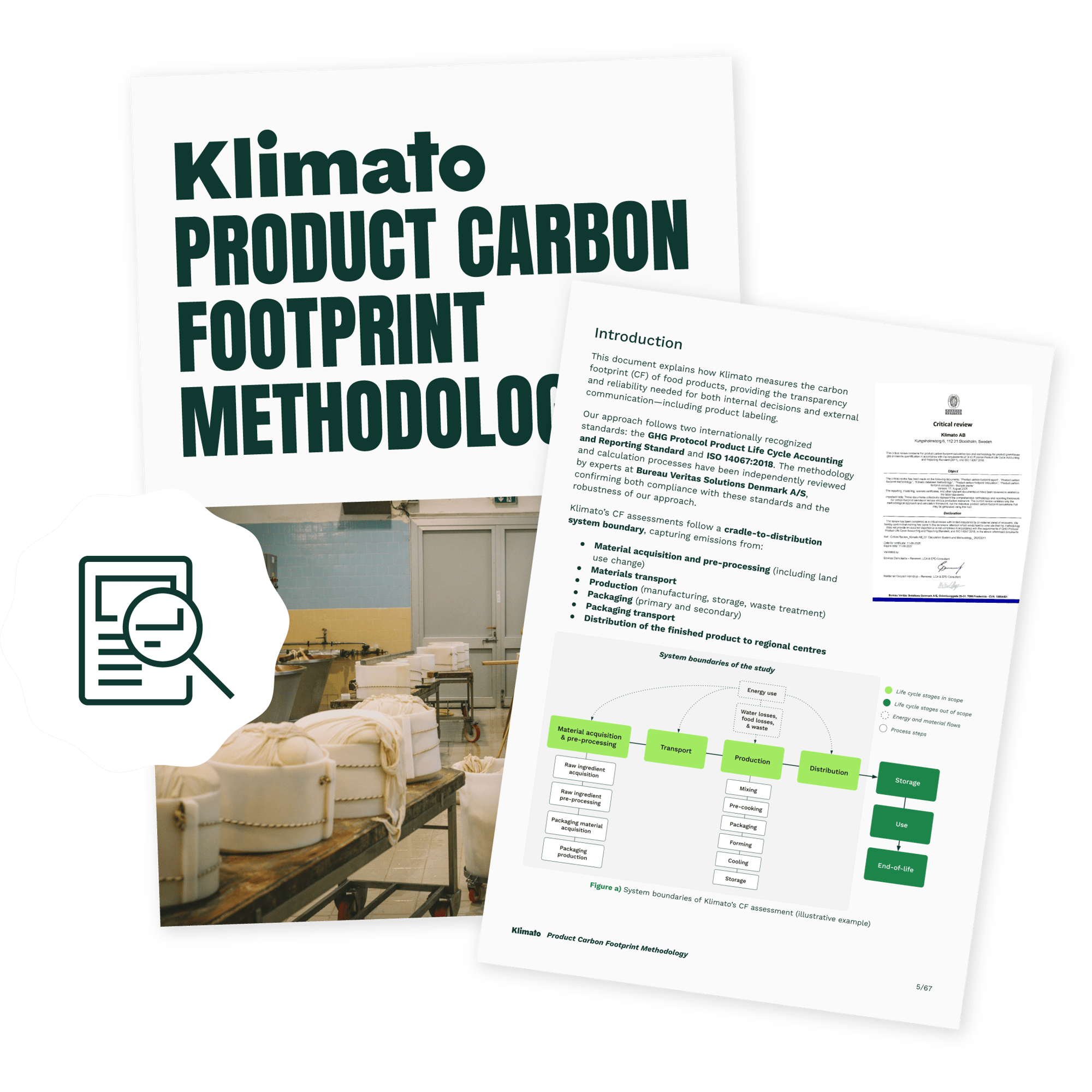
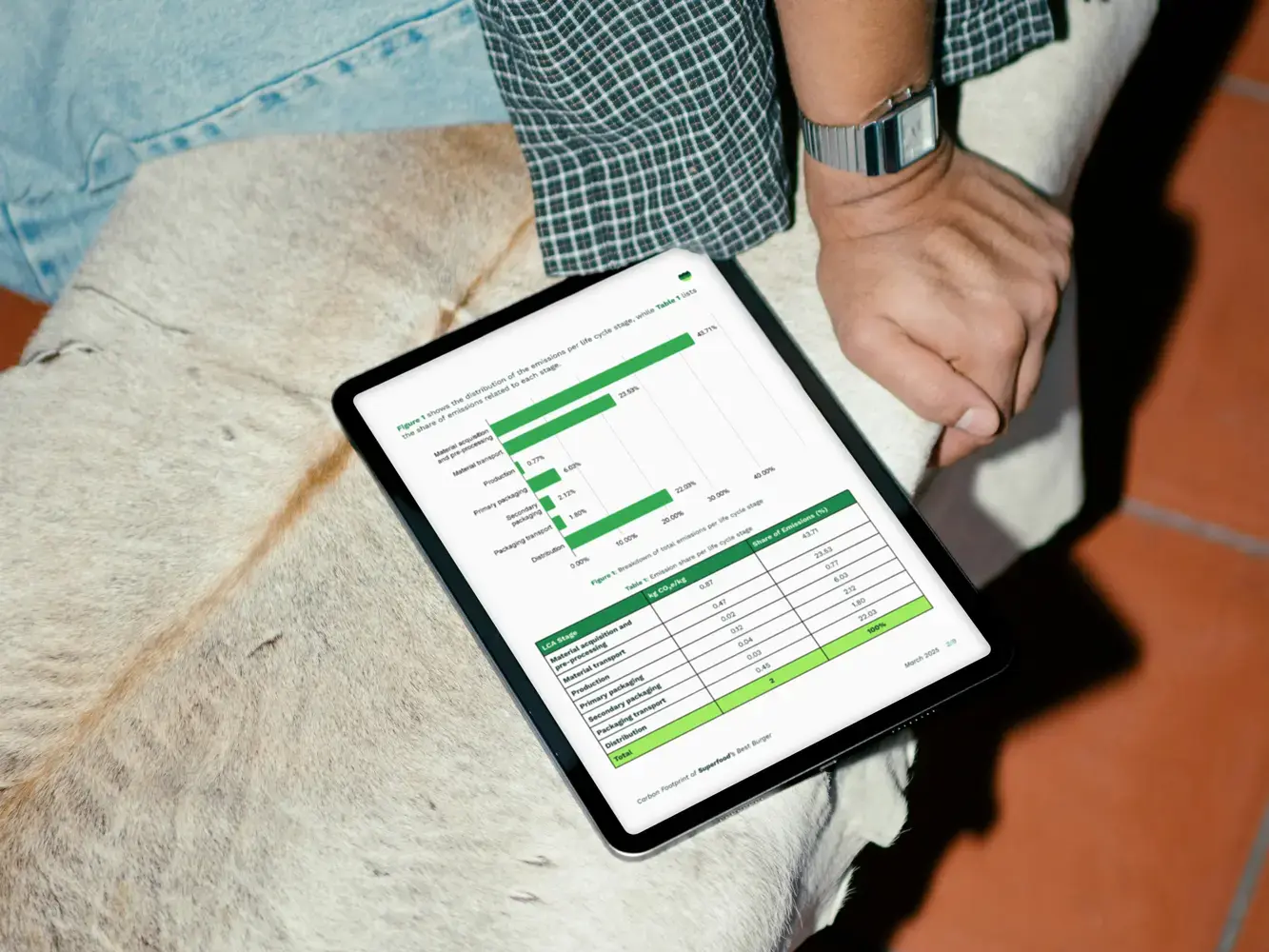
Calculate the carbon footprint of individual products or your full portfolio using Klimato's food-specific emission database—verified by the World Resources Institute and IVL, and aligned with ISO 14067 and the GHG Protocol Product Standard. Receive a full carbon footprint report, an on-pack carbon label, and listing in the Klimato Climate Impact Database, where foodservice buyers search for lower-impact ingredients.
Best for: Food producers responding to buyer requests, preparing for Green Claims compliance, or looking to differentiate at retail or in tenders.
Food Emissions Management

Map your full procurement and ingredient data to food-specific emission factors, and build ongoing visibility into the emissions embedded in what you buy and sell. This powers your Scope 3 Category 1 reporting and gives procurement teams the data to make lower-carbon sourcing decisions.
Best for: Food producers building operational emissions insights or managing Scope 3 reporting obligations.
Corporate Carbon Accounting

Complete Scope 1–3 emissions reporting for your organization, aligned with the GHG Protocol and major disclosure frameworks including CSRD, SBTi, and GRI. Klimato manages data collection, emission factor mapping, and report delivery—so your team focuses on decisions, not methodology.
Best for: Food producers under CSRD obligation, setting SBTi targets, or reporting to investors and customers on full organizational emissions.

Why Food Producers Choose Klimato

World-Leading Food Emissions Data
Klimato's database contains over 20,000 food-specific emission factors—more than any generic carbon accounting platform. It is verified by IVL Swedish Environmental Research Institute and the World Resources Institute, and maintained by an in-house science team.

Built For the
Food Industry
Klimato works exclusively within food and beverage. Our methodology accounts for the ingredient-level complexity, sourcing variation, and procurement data structure that generalist tools are not built to handle.

Methodology That
Stands Up to Scrutiny
Every figure is traceable to its data source. Our product carbon footprint methodology has been critically reviewed by Bureau Veritas. Our corporate reporting methodology is aligned with the GHG Protocol and supports all major disclosure frameworks.
Seamless Integrations
Klimato connects with procurement and ERP systems used across the food industry, reducing the manual work of data collection and making it easier to keep emissions data current.

Expert Guidance
Our team includes environmental scientists and food industry specialists. From onboarding to annual reporting cycles, you have direct access to people who understand both the science and the commercial realities of food sustainability.
PRODUCING FOR THE PLANET
Trusted by Food Producers Worldwide
Great dishes start with great ingredients, and food producers play a key role in building more sustainable menus. Companies like Flora Food Group, Quorn, Bonduelle, Redefine Meat, and Moving Mountains use Klimato to understand and communicate their climate impact.
Frequently Asked Questions
Why do food producers need to measure their carbon footprint?
Food production is responsible for approximately 34% of global greenhouse gas emissions. For food producers specifically, buyers, retailers, and regulators are increasingly requiring verified emissions data as a condition of doing business. Beyond compliance, credible carbon data supports brand differentiation, tender wins, and progress toward science-based emissions targets.
What is the most important emissions category for food producers to measure?
For most food producers, Scope 3 Category 1—the emissions embedded in purchased raw materials and ingredients—is the largest and most commercially relevant source of emissions. Measuring it requires food-specific emission factor data, which generalist carbon accounting tools are not built to provide at the ingredient level.
What regulations apply to food producer sustainability reporting?
The most immediately relevant regulations for food producers are the EU Green Claims Directive (requires verified data to substantiate environmental claims on products), CSRD (mandates organizational sustainability reporting and will extend Scope 3 data requirements up the supply chain), and SBTi FLAG guidance (sector-specific emissions targets for food and agriculture companies). Voluntary frameworks including GRI, CDP, and ISSB/IFRS are also widely used by food producers reporting to investors and enterprise customers.
What is the EU Green Claims Directive and how does it affect food producers?
The EU Green Claims Directive requires that any environmental or climate-related claim made about a product be substantiated by verified, science-based data aligned with recognized methodologies. For food producers, this means that claims like "low carbon," "climate-friendly," or any carbon footprint figure displayed on packaging or in marketing must be backed by a credible product carbon footprint calculation. Vague or unsubstantiated claims will be prohibited once the directive is in force.
How does product carbon footprint data help food producers win more business?
Verified product carbon footprint data directly supports commercial outcomes in several ways: it answers buyer sustainability questionnaires and RFP requirements, meets the sustainability criteria included in over 60% of European tenders, enables credible on-pack carbon labeling that builds consumer trust, and increases visibility among foodservice operators and caterers searching for lower-impact ingredient suppliers through platforms like the Klimato database.
How does Klimato's data connect to my customers' Scope 3 reporting?
When your food producer customers use Klimato Carbon Accounting for their own Scope 3 reporting, your verified product carbon footprint data can feed directly into their Category 1 calculations. This makes your products easier to work with for sustainability teams and strengthens your supplier relationships with companies under CSRD or SBTi obligations.
What is a product carbon footprint and how is it calculated?
A product carbon footprint (PCF) measures the total greenhouse gas emissions generated across a product's life cycle—typically from raw material extraction through to distribution—expressed in kg CO₂e per unit or per kilogram of product. Klimato calculates PCFs using food-specific emission factors from a database of over 20,000 data points, aligned with ISO 14067 and the GHG Protocol Product Standard.
Ready to Turn Your Climate Performance into a Competitive Advantage?
Klimato helps food producers measure what matters, communicate it credibly, and use it to grow—whether you're responding to your first buyer request or building a full corporate emissions program.