
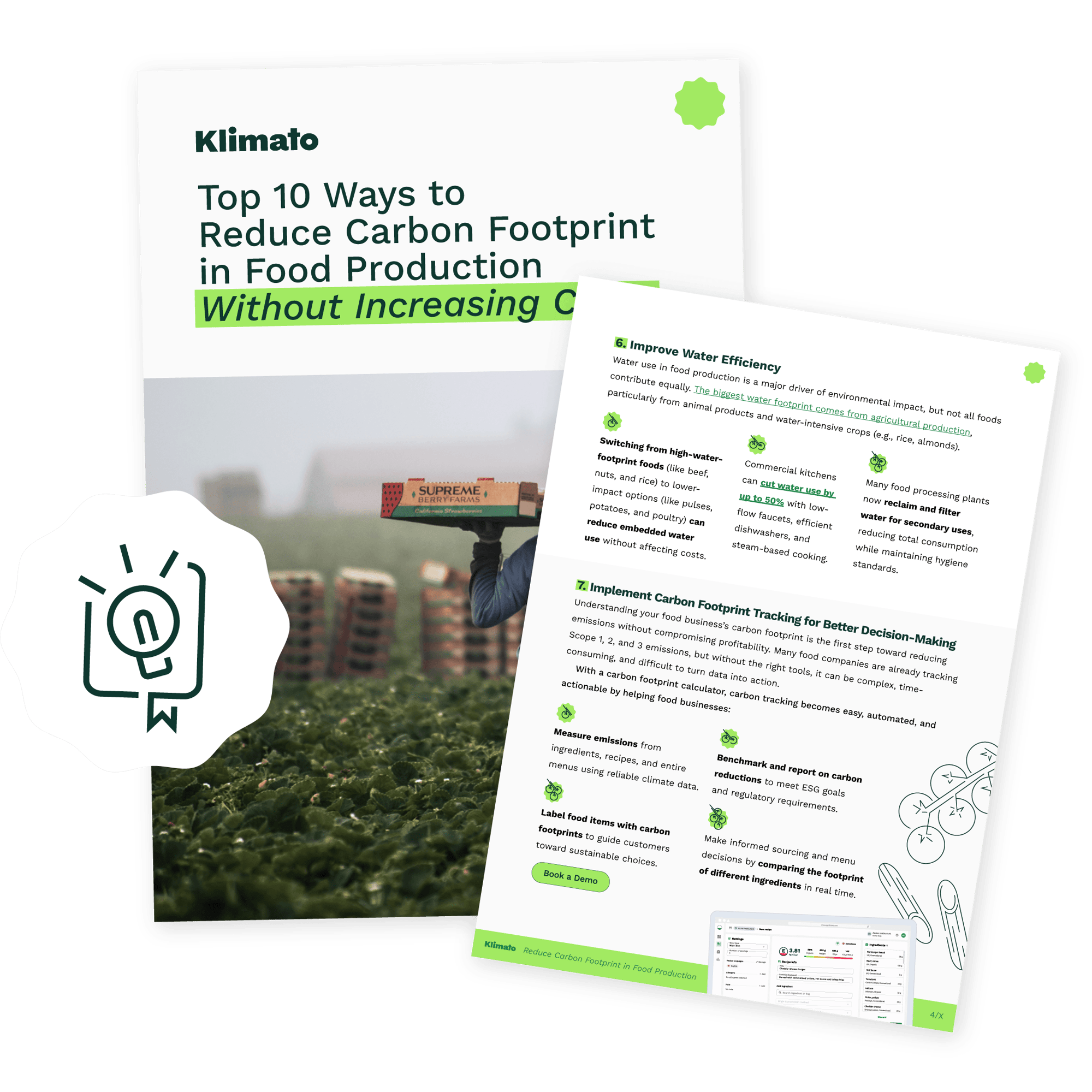
Top 10 Ways to Reduce Carbon Footprint in Food Production Without Increasing Costs
Reducing the carbon footprint of food production is not just an environmental responsibility—it’s a way to drive cost efficiency, operational resilience, and customer loyalty. The food industry faces increasing pressure to cut emissions without cutting margins, and the good news is that it’s entirely possible.
This guide breaks down 10 practical, cost-effective strategies that food producers can implement to reduce their environmental impact while maintaining strong financial performance.
Request guide
FAQ About Carbon Reduction Strategies

How can food producers reduce their carbon footprint without increasing costs?
Reducing carbon footprint in food production and reducing costs are largely the same exercise. The highest-emission inputs—energy-intensive processing, carbon-heavy raw materials, inefficient logistics—are also the most expensive. Producers that measure their emissions at the ingredient and process level can identify exactly where to make changes that improve both their environmental impact and their cost base simultaneously. Read about sustainable food production: a supplier's guide and how food producers use carbon footprint calculation to boost profits.
What are the biggest sources of carbon emissions in food production?
The largest emissions sources in food production vary by product category, but ruminant livestock—beef and lamb—consistently generate the most CO2e per kilogram of output due to methane emissions and land use requirements. Dairy, rice, and highly processed foods also carry significant footprints. For most producers, agricultural raw materials account for the majority of total emissions, making supplier and ingredient selection the highest-leverage area for reduction. Explore food carbon footprint: tools, methods, and impact and FLAG emissions explained for food businesses.
How does lifecycle assessment (LCA) help food producers reduce emissions?
A lifecycle assessment measures the total greenhouse gas emissions of a food product across its entire value chain—from raw material production and processing through to packaging and distribution. For food producers, LCA data reveals exactly which stages and ingredients drive the most impact, enabling targeted improvements rather than broad guesswork. It also provides the verified, methodology-backed figures that retailers and foodservice buyers increasingly require from their suppliers. Learn more about LCA explained for food businesses and how to harness the power of your food supply chain with LCAs.
How can food producers use carbon data to strengthen relationships with buyers?
Buyers in retail and foodservice are under growing pressure to report their scope 3 emissions, which include the carbon footprint of everything they purchase. Food producers that supply verified, product-level carbon data make it significantly easier for buyers to meet these obligations—and are therefore preferred over suppliers who cannot. Carbon transparency is becoming a baseline expectation in supplier qualification, not a differentiator. See 5 sustainability strategies for food producers to win buyers and what credible food climate data looks like from a buyer's perspective.
What role does supply chain transparency play in reducing food production emissions?
Supply chain transparency is the foundation of effective emissions reduction for food producers. Without visibility into where emissions occur across the supply chain—from farm to factory gate—it is impossible to prioritize reductions or verify progress. Producers that invest in ingredient-level carbon data gain an accurate picture of their full footprint and can work with suppliers on targeted improvements. Read about ingredient-level data for accurate scope 3 reporting and scope 3 data readiness for food businesses.