
Scope 3 Emissions Explained: A Quick Guide for Food Professionals
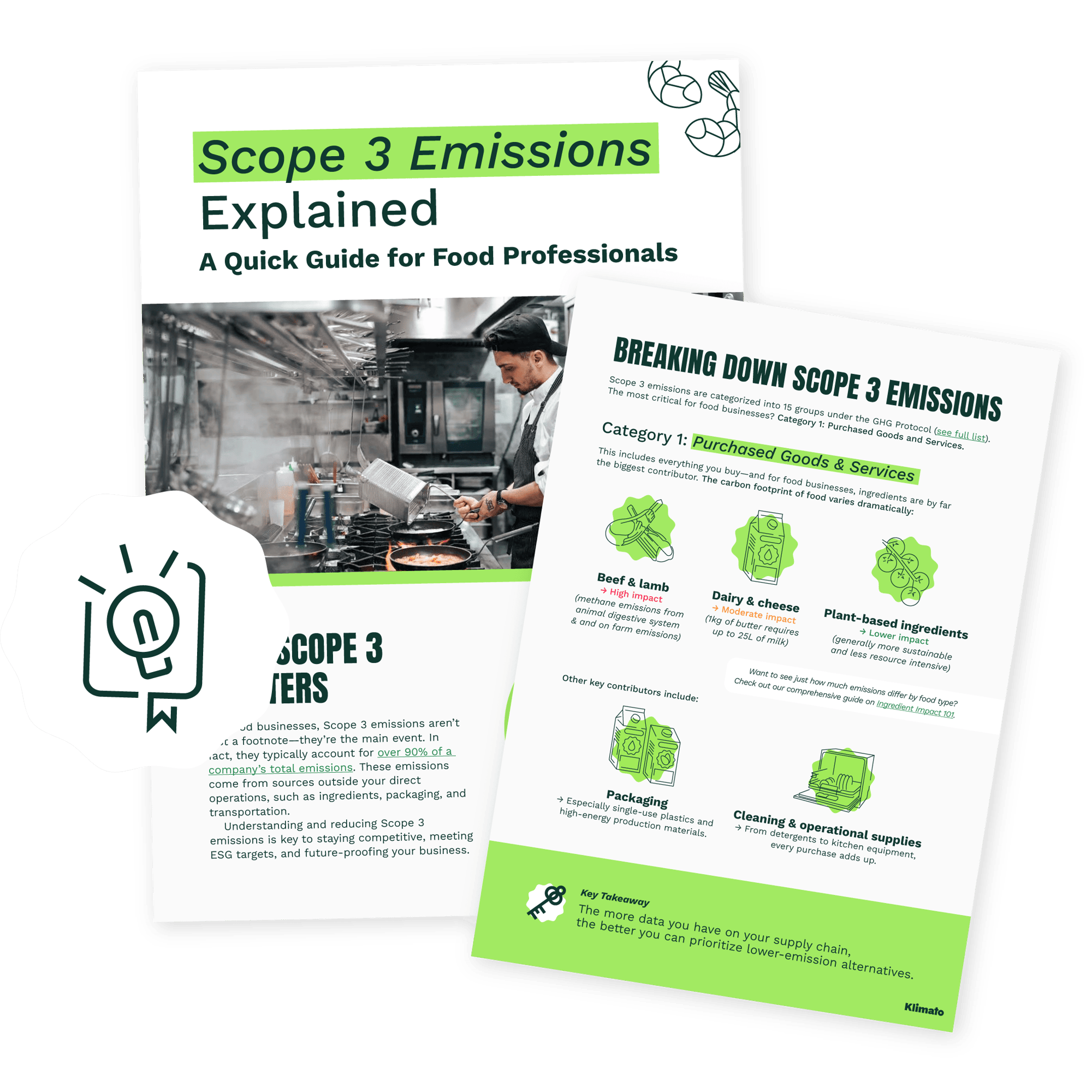
For food businesses, Scope 3 emissions aren’t just a footnote—they’re the main event. In fact, they typically account for over 90% of a company’s total emissions. These emissions come from sources outside your direct operations, such as ingredients, packaging, and transportation.
Understanding and reducing Scope 3 emissions is key to staying competitive, meeting ESG targets, and future-proofing your business.
Request guide
FAQ About Scope 3 Emissions

What are scope 3 emissions and why do they matter for food businesses?
Scope 3 emissions are all indirect greenhouse gas emissions that occur across a company's value chain—both upstream (suppliers, raw materials, ingredients) and downstream (product use, end-of-life). For food businesses, scope 3 typically accounts for over 90% of total emissions, making it by far the most significant category. Understanding and measuring scope 3 is therefore not optional for any food business serious about sustainability targets or regulatory compliance. Read a visual guide to scope 1, 2, and 3 emissions explained for food businesses and examples of scope 1, 2, and 3 emissions in food businesses.
What is included in scope 3 emissions for a food business?
For food businesses, scope 3 upstream emissions include the carbon footprint of all purchased ingredients, packaging materials, and logistics—everything that happens before a product reaches the facility. Downstream scope 3 covers distribution, retail, consumer use, and food waste. In practice, ingredient procurement dominates: the farming, processing, and transport of raw materials accounts for the vast majority of a food operator's total carbon footprint. Explore how to calculate scope 3 emissions for food businesses and a practical guide to scope 3 reporting for food businesses.
Why is scope 3 reporting more challenging for food businesses than other industries?
Food businesses face unique scope 3 complexity because their purchased goods emissions—category 1 of the GHG Protocol—come from hundreds or thousands of different ingredients, each with a different carbon intensity depending on origin, production method, and season. Generic spend-based estimation approaches are far too imprecise for this level of variation. Accurate food scope 3 reporting requires activity-based, ingredient-level LCA data, which most standard carbon accounting tools are not built to handle. Find out why generic carbon calculators don't work for food and why climate reporting fails food businesses without the right infrastructure.
What is the difference between spend-based and activity-based scope 3 calculation for food?
Spend-based scope 3 calculation estimates emissions by multiplying procurement spend by an average emissions factor per dollar spent. Activity-based calculation uses actual ingredient quantities and product-specific LCA emissions factors, producing far more accurate results. For food businesses, the difference is significant—a kilogram of beef and a kilogram of lentils might cost the same but have radically different carbon footprints. Regulators and buyers are increasingly requiring activity-based data. Learn more about ingredient-level data for accurate scope 3 reporting and is your food carbon footprint accurate?
How does CSRD affect scope 3 reporting requirements for food businesses?
Under the Corporate Sustainability Reporting Directive (CSRD), food businesses in scope must disclose their material environmental impacts—including full scope 3 emissions—using the European Sustainability Reporting Standards (ESRS). For food operators, this means ingredient-level procurement data is now a compliance requirement, not just a best practice. Businesses that have already built food emissions measurement into their operations will face significantly lower reporting costs and audit risk. Read the CSRD food reporting risk check: where teams get challenged and how to prepare CSRD reporting for food businesses.