
Maximizing Menu Profitability Through Climate-Smart Choices
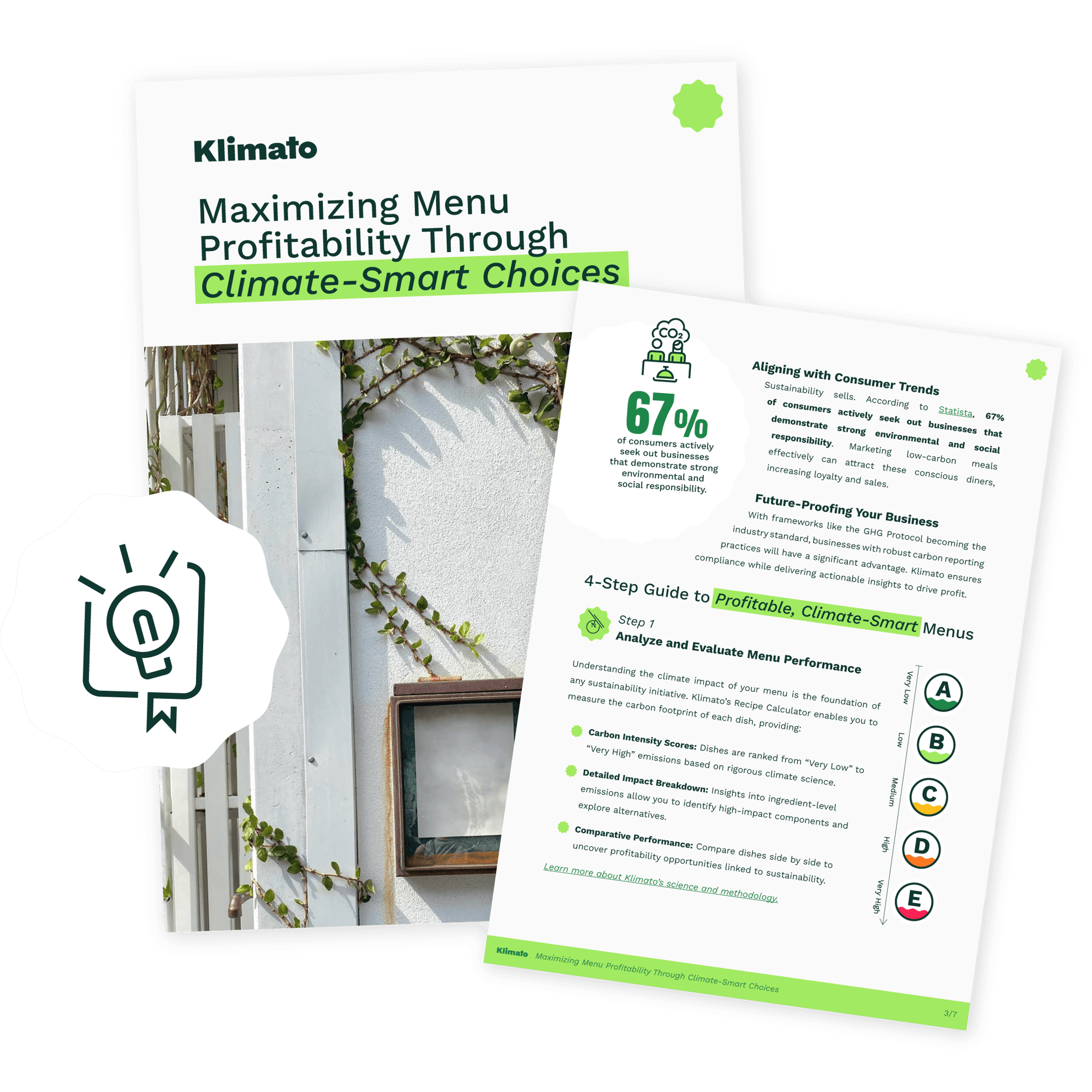
Embracing sustainability is not only a strategy to reduce environmental and social impacts of a company's operations—it is a proven strategy for boosting profitability. With growing consumer demand for eco-conscious dining and increased regulatory pressure, businesses must adapt to stay ahead. This guide will equip you with practical, data-driven strategies to optimize your menu, boost sales, and align profitability with sustainability.
Request guide
FAQ About Maximizing Menu Profitability
.webp?width=2000&height=1333&name=anthony-lim-PnGxqFbt2R4-unsplash%20(1).webp "anthony-lim-PnGxqFbt2R4-unsplash (1)")
What is climate-smart menu design and how does it improve profitability?
Climate-smart menu design uses carbon footprint data alongside cost and sales performance data to identify which dishes deliver the best outcome across all three dimensions—margin, emissions, and customer appeal. Because high-carbon ingredients are typically the most expensive to source, redesigning a menu around lower-carbon choices almost always improves food cost percentage at the same time. The result is a menu that is simultaneously more profitable, more sustainable, and more competitive. Read about how sustainability practices can drive profitability in food service and from carbon data to better food decisions.
How can restaurants use carbon data to optimize their menus?
Carbon data enables a new layer of menu analysis, sitting alongside traditional food cost and sales mix reporting. When a restaurant maps every dish by CO2e per serving, it immediately reveals which items are carrying disproportionate environmental cost. From there, chefs and operators can make targeted substitutions, adjust portion sizes, or reposition dishes to nudge diners toward higher-margin, lower-carbon options. This is data-driven menu engineering applied to sustainability. See green menu makeover: boost your sales with climate labeling and how carbon labels change customer behavior in the food industry.
Which menu items typically have the highest carbon footprint?
Across most restaurant and catering menus, dishes featuring beef—particularly burgers, steaks, and slow-cooked cuts—carry the highest CO2e per serving, followed by lamb, cheese-heavy dishes, and those with significant dairy content. A single beef dish can generate five to ten times the emissions of a comparable plant-based option. For operators looking to reduce menu carbon intensity quickly, these categories represent the highest-leverage starting point. Explore food carbon footprint: tools, methods, and impact and food carbon footprint benchmarks: see how you compare.
Can plant-based menu options genuinely compete with meat dishes on taste and revenue?
Yes, and the commercial case for plant-forward menu development has never been stronger. Plant-based dishes carry significantly lower ingredient costs, higher margins, and lower carbon footprints than meat-equivalent dishes. With the right development, presentation, and positioning—including carbon labels that highlight their climate credentials—they attract both sustainability-conscious diners and those simply drawn to well-crafted, interesting food. The sustainable food production trends driving this shift show no sign of slowing. Read about sustainable food production trends shaping the industry and 5 ways to boost profit while going green.
How does menu profitability analysis change when carbon data is included?
Traditional menu engineering plots dishes on a matrix of margin and popularity. Adding a carbon dimension creates a three-way analysis: dishes that are high-margin, popular, and low-carbon are clear winners to promote; dishes that are high-carbon, low-margin, and underperforming are candidates for removal or reformulation. This richer picture enables smarter decisions—and gives operators a defensible, data-backed rationale for menu changes that also improve sustainability performance. See maximize ROI with an accurate emissions calculator and how to maximize profitability in the hospitality and food industry.