
How Integrations Can Streamline Your Climate Reporting
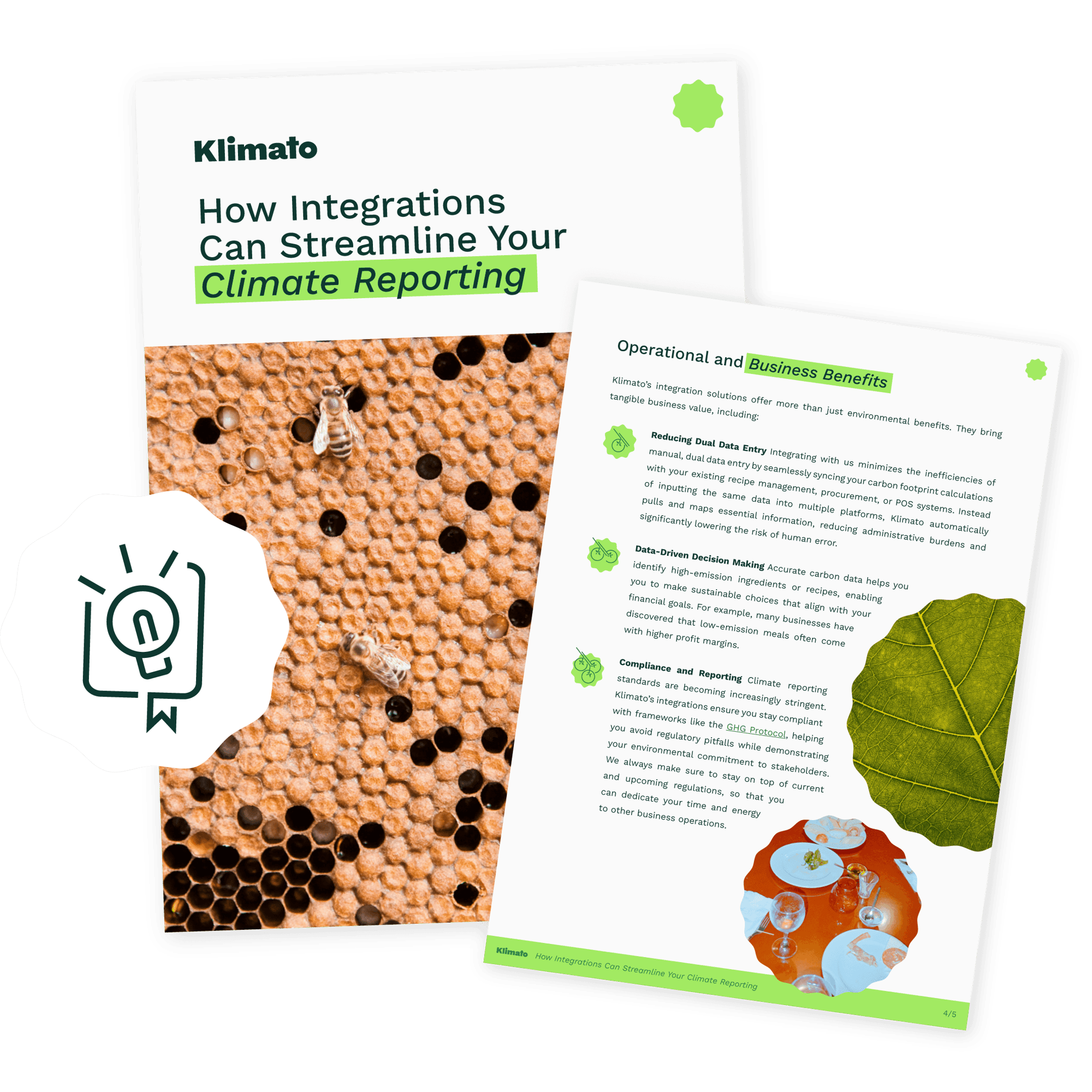
Request guide
FAQ About Klimato Carbon Accounting
How do software integrations help food businesses streamline climate reporting?
Integrations connect a carbon calculation platform directly to the systems food businesses already use—recipe management software, procurement platforms, ERP systems, and POS tools—so that emissions data updates automatically as ingredients, quantities, and suppliers change. This eliminates the need for manual data entry and recalculation, turning climate reporting from a periodic, labor-intensive exercise into a continuous, accurate process. For enterprise operations managing hundreds of recipes across multiple sites, integrations are what make accurate carbon reporting operationally viable. Explore Klimato's integration options for food businesses and how to calculate scope 3 emissions for food businesses.
What systems can be integrated with a food carbon reporting platform?
Food carbon reporting platforms can typically integrate with recipe management and menu costing software, procurement and purchasing systems, ERP platforms, and inventory management tools. These integrations allow ingredient-level purchase data to flow directly into carbon calculations without manual intervention. For food businesses operating at scale—multi-site restaurants, contract caterers, hotel groups—this connectivity is essential for keeping emissions figures current and accurate across a large and frequently changing product range. Read about Klimato's carbon accounting software for food and Klimato's partnership with Procure Wizard.
Why is manual climate reporting a problem for food businesses?
Manual climate reporting requires teams to periodically export procurement data, match ingredients to emissions factors, calculate dish-level CO2e figures, and compile results into reports—a process that is time-consuming, error-prone, and difficult to scale. It also produces point-in-time snapshots rather than continuous data, meaning figures can be significantly out of date by the time they are used for decision-making or external reporting. As reporting obligations increase under CSRD and similar frameworks, manual processes become a growing liability. See why climate reporting fails food businesses and scope 3 data readiness for food businesses.
How do integrations improve the accuracy of food carbon footprint data?
Integrations improve accuracy by pulling live, activity-based data directly from procurement and recipe systems—replacing the estimated or averaged figures that manual processes often rely on. When ingredient quantities, supplier sources, and recipe compositions update in real time, carbon figures reflect actual purchasing decisions rather than historical assumptions. This level of accuracy is increasingly required by CSRD auditors, corporate clients evaluating scope 3 data, and sustainability certification bodies. Learn about ingredient-level data for accurate scope 3 reporting and is your food carbon footprint accurate?
How do integrations support CSRD compliance for food businesses?
CSRD requires food businesses to report material scope 3 emissions with sufficient granularity and auditability to satisfy external verification. Manual, spreadsheet-based reporting struggles to meet this bar—it is difficult to trace, hard to update, and prone to inconsistency across reporting periods. Integrated carbon platforms create an auditable data trail from procurement through to reported figures, providing the documentation trail that CSRD verification requires. Read how to prepare CSRD reporting for food businesses and the CSRD food reporting risk check: where teams get challenged.