
How Climate Labeling Impacts Consumer Choices
In a time where sustainability is no longer an optional consideration, food businesses face a dual challenge: reducing their environmental impact while appealing to an increasingly eco-conscious customer base. Climate labeling offers a crucial solution by increasing transparency and empowering consumers to make informed choices. But how exactly does climate labeling influence consumer behavior— and, more importantly, your bottom line?
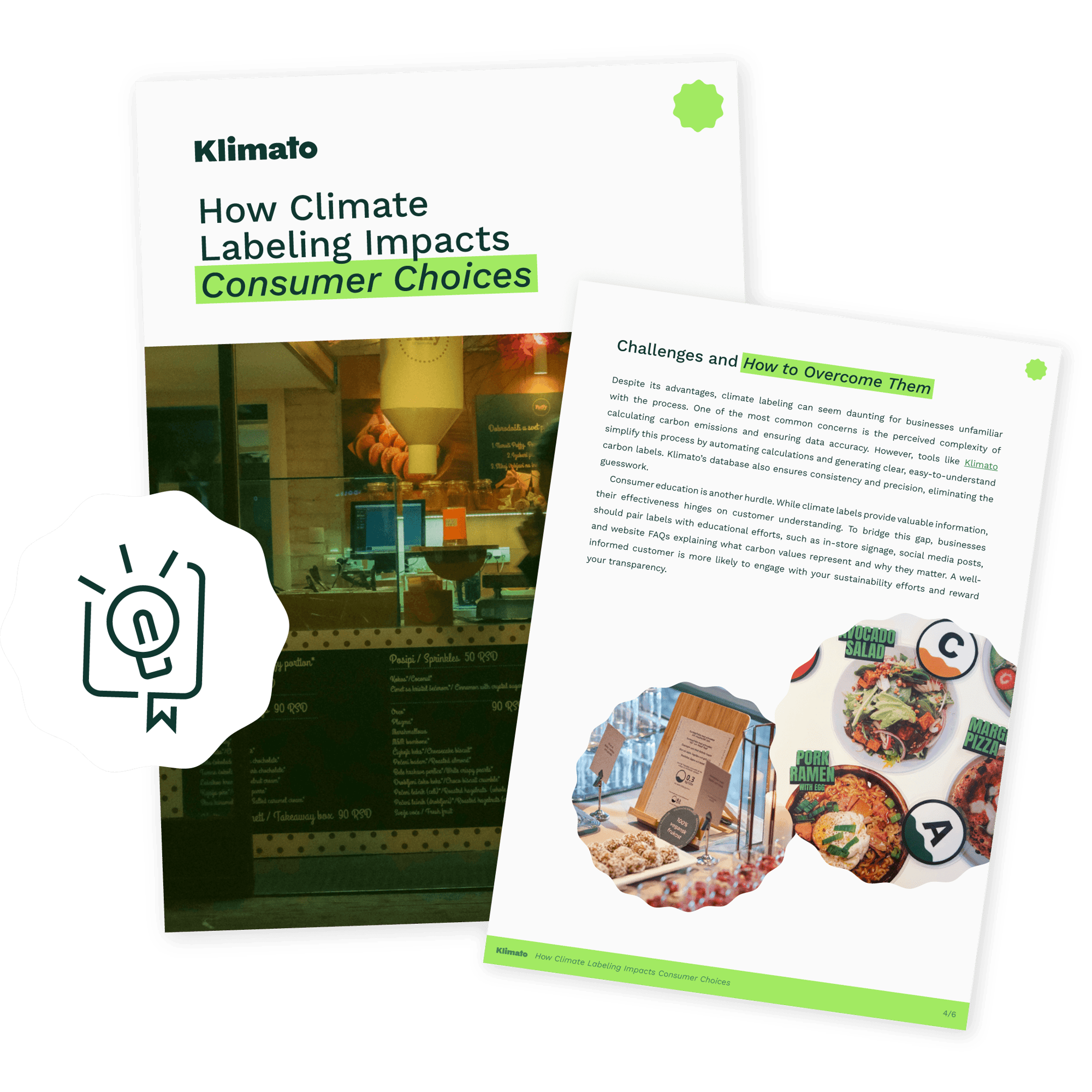
Request guide
FAQ About Climate Labeling and Consumer Choices
Does climate labeling actually influence what consumers order?
Yes! Research consistently shows that displaying carbon labels at the point of purchase shifts consumer choices toward lower-carbon options. The effect is most pronounced when labels are simple, comparative, and framed positively. Consumers don't need to be highly eco-conscious to respond: even moderate awareness of climate impact nudges decisions when the information is presented clearly and without friction. For food businesses, this behavioral shift translates directly into menu performance and emissions outcomes. Read more about how carbon labels change customer behavior in the food industry and from carbon data to better food decisions.
What type of consumer is most influenced by climate labels on food?
Younger consumers—particularly millennials and Gen Z—show the strongest response to climate labeling, as sustainability is a more deeply embedded value in their purchasing decisions. However, research also shows that climate labels influence a broader population than expected, including older demographics who associate transparency with quality and trustworthiness. Corporate dining and catering contexts also see strong uptake, as employers and event clients increasingly want to offer guests climate-informed choices. See how carbon labels change customer behavior in the food industry and green menu makeover: boost your sales with climate labeling.
How should climate labels be displayed on a menu to maximize impact?
Effective climate label design follows the same principles as nutrition labeling—simple, consistent, and comparable across options. Color-coded systems that allow diners to quickly identify low, medium, and high-carbon dishes outperform raw CO2e numbers alone. Placing labels alongside price and dish name, rather than in a footnote or separate section, maximizes visibility and decision-making impact. Positive framing—highlighting low-carbon choices—consistently outperforms warning-based approaches. Explore what a carbon emission label is and why the food industry needs it and Klimato's carbon labeling software for food businesses.
Can climate labeling help food businesses increase sales of specific dishes?
Yes! Climate labels can function as a promotional tool for lower-carbon dishes, drawing attention to options that might otherwise be overlooked. When a dish is highlighted as a climate-friendly choice, it gains a secondary value proposition beyond taste and price. This is particularly effective for plant-forward dishes that may have carried a perception of compromise—a carbon label reframes them as a positive, considered choice. Read about how to drive food business growth with carbon labeling and reporting and 5 ways to maximize ROI with climate labeling.
Does climate labeling improve customer trust and brand loyalty?
Transparency consistently builds trust, and food businesses that display verified carbon labels signal confidence in their sustainability claims. Consumers are increasingly skeptical of vague green marketing, and a specific, data-backed carbon label carries significantly more credibility than general sustainability messaging. This translates into stronger brand loyalty, higher repeat visit rates, and positive word-of-mouth among sustainability-conscious diners. Explore how restaurants can turn sustainability into a competitive advantage and how to prove your sustainability with verified data.