
Financial Benefits of Setting Climate Targets for Food Procurement
Climate-conscious procurement is not just about meeting expectations from regulators or customers; it’s about unlocking growth, boosting margins, and safeguarding your business against future uncertainties. From cutting costs through operational efficiencies to winning over new customers and standing out from competitors, sustainability is a golden opportunity to create real, measurable value.
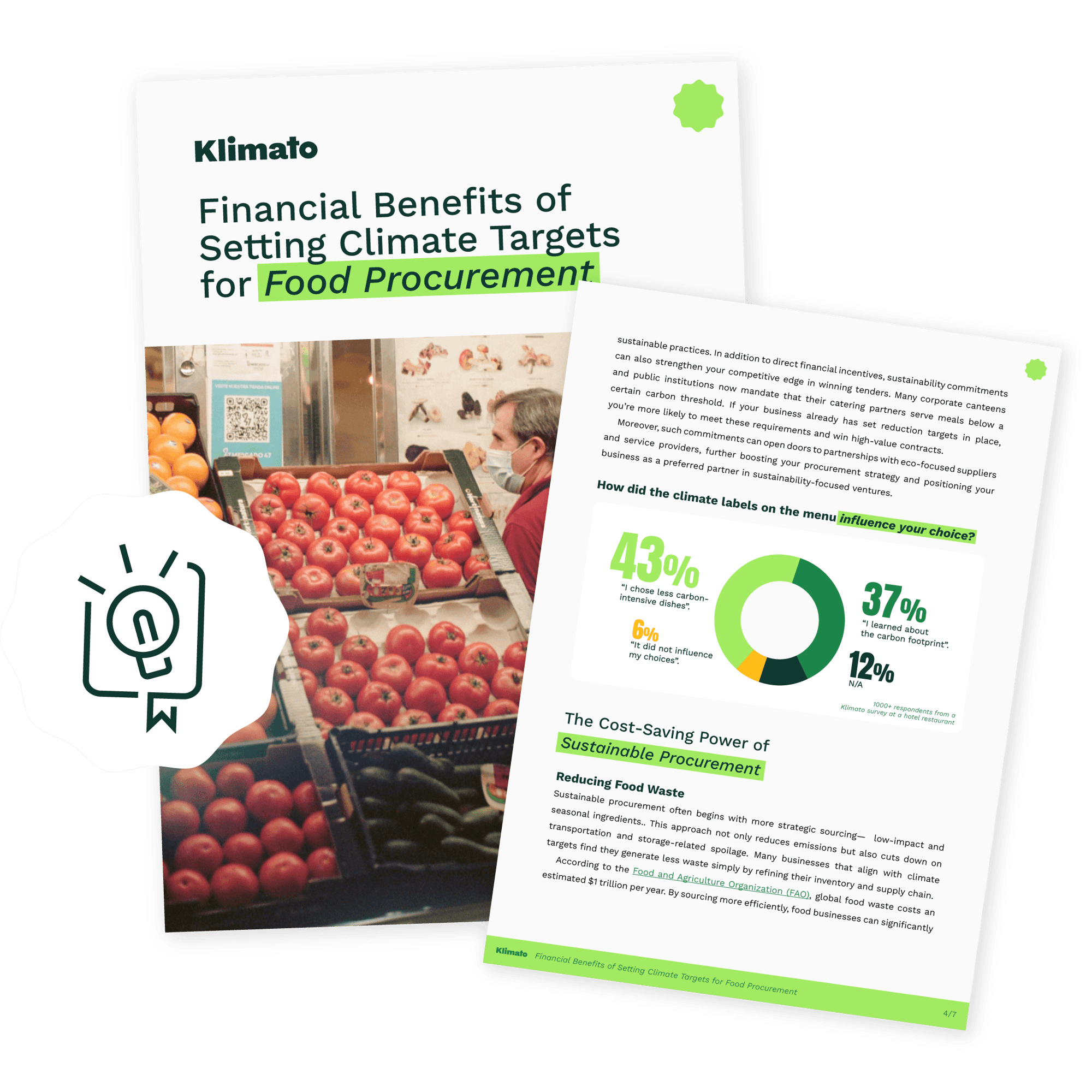
Request guide
FAQ About Setting Climate Targets

What are the financial benefits of setting climate targets for food procurement?
Setting climate targets for food procurement creates financial value in several compounding ways: it drives down ingredient costs by shifting purchasing toward lower-carbon, typically lower-cost alternatives; it reduces exposure to future carbon taxes and regulatory penalties; it strengthens positioning in sustainability-weighted tenders; and it provides the verified data that investors and lenders increasingly require. Procurement teams that treat climate targets as a financial strategy rather than a compliance obligation consistently unlock the strongest returns. Read about the financial benefits of sustainable catering and how sustainability practices can drive profitability in food service.
How do climate targets in food procurement reduce operational costs?
The most direct cost saving from climate-targeted procurement comes from reducing reliance on high-carbon ingredients—primarily ruminant meat and dairy—which are consistently among the most expensive items to source. Shifting purchasing toward lower-carbon proteins, seasonal produce, and more efficient supply chains reduces both the carbon footprint and the food cost per portion simultaneously. Over time, this compounds into meaningful margin improvement across the operation. Explore how food producers use carbon footprint calculation to boost profits and how to maximize profitability in the hospitality and food industry.
How do food procurement climate targets help businesses win contracts and tenders?
Corporate clients, public sector buyers, and large institutional clients now routinely include sustainability criteria in their procurement requirements—from verified emissions data to demonstrated reduction trajectories. Food businesses that have set and are actively tracking climate targets for their procurement can respond to these requirements with hard evidence, while competitors without targets are left offering generic sustainability claims. This directly improves win rates in competitive tender processes. See sustainability criteria in corporate catering tenders explained and how sustainable caterers win more contracts with less effort.
How does setting climate targets for food procurement protect against future carbon taxes?
Carbon pricing mechanisms—including carbon taxes and emissions trading schemes—are expanding across the EU and other major markets. Food businesses with high-carbon procurement profiles face growing exposure as these mechanisms extend to agricultural supply chains. Setting and acting on climate targets now reduces that exposure systematically, so that when carbon costs increase, the business has already shifted its purchasing toward lower-risk, lower-carbon ingredients. Assess your carbon tax exposure as a food business and read how food businesses should stay ahead of climate regulations.
What data does a food business need to set meaningful climate targets for procurement?
Meaningful procurement climate targets require an accurate baseline—specifically, the CO2e emissions embedded in current ingredient purchasing, broken down by category and supplier. Without this, targets are arbitrary and progress is unmeasurable. Activity-based, ingredient-level LCA data provides the foundation needed to set targets that are both ambitious and credible, and to track progress with the precision that regulators, investors, and clients increasingly expect. Learn about scope 3 data readiness for food businesses and what credible food climate data looks like.