
Klimato Sustainability Report 2024
The food system is responsible for a third of global greenhouse gas (GHG) emissions, making sustainable solutions more urgent than ever. When Klimato launched in 2017, carbon footprint data for food products was fragmented and hard to access. So, we built a platform that makes this data easy to use—helping the food service industry take climate action with confidence.
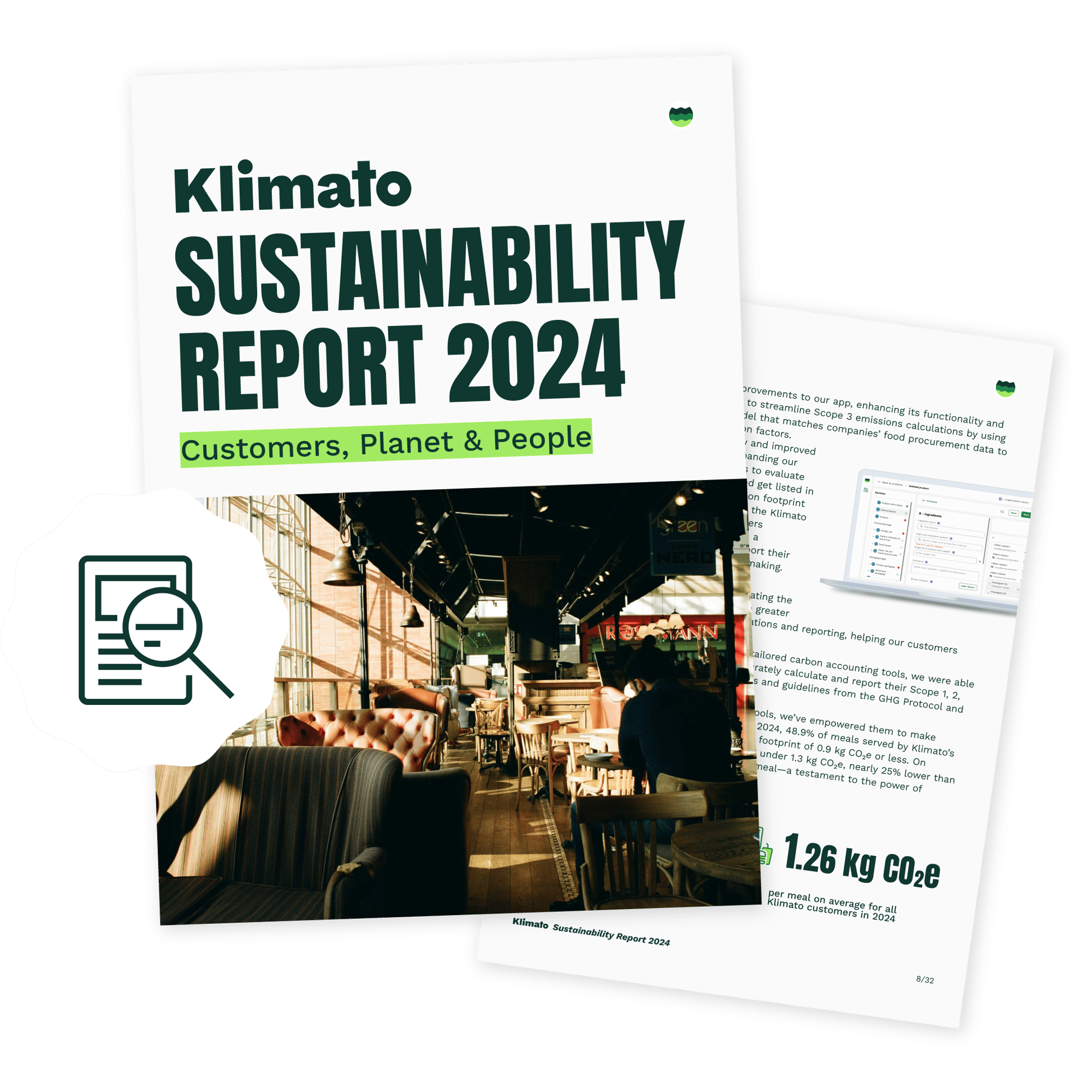
Fill out the form below to access our Sustainability Report for 2024, featuring a rundown of our sustainability efforts in terms of our customers, our planet, and our people.
Request Report
FAQ About Sustainability Reporting for Businesses
.jpg?width=2000&height=1348&name=annie-spratt-80n_J7TsQX0-unsplash%20(1).jpg "annie-spratt-80n_J7TsQX0-unsplash (1)")
Why does the food system produce so many greenhouse gas emissions?
The food system accounts for roughly a third of global greenhouse gas emissions, making it one of the largest contributors to climate change. The majority comes from agricultural production—particularly livestock farming, which generates methane and requires vast land and water resources—along with deforestation, soil degradation, food waste, and transport. For food businesses, this scale of impact also represents the greatest opportunity: reducing food emissions is one of the most effective levers available for meaningful climate action. Read more about examples of scope 1, 2, and 3 emissions in food businesses and the impact of food supply chains from field to fork.
What should a food business sustainability report include?
A credible food business sustainability report should cover emissions across all three scopes—energy and facilities (scope 1 and 2) as well as supply chain and food procurement (scope 3). It should include a baseline measurement, year-on-year progress against reduction targets, methodology disclosures, and evidence of third-party data validation. Reports that rely on spend-based estimates rather than activity-based food data are increasingly scrutinised by investors, clients, and regulators. Learn about what credible food climate data looks like and how to prepare CSRD reporting for food businesses.
How has carbon footprint data for food products improved in recent years?
Historically, carbon footprint data for food ingredients was fragmented, inconsistent, and difficult to apply at the dish level. Advances in lifecycle assessment (LCA) methodology, combined with food-specific software platforms, have made it far more accessible and actionable. Today, restaurants, caterers, and hotels can calculate per-dish CO2e figures automatically from their recipe data—something that would have required specialist consultants a decade ago. Read more about LCA explained for food businesses and how to calculate the carbon footprint of food.
What is the GRI standard and why does it matter for food sustainability reporting?
The Global Reporting Initiative (GRI) is one of the most widely used frameworks for sustainability reporting, providing standardized disclosures that allow stakeholders to compare performance across organisations. For food businesses, GRI-aligned reporting signals credibility and transparency—particularly when combined with verified emissions data. It also provides a foundation that maps onto other frameworks such as CSRD and the GHG Protocol. Find out more about Klimato's GRI licence and what it means for your business and how CSRD, scope 3, and SBTi work together for food businesses.
How do food businesses set and track meaningful sustainability targets?
Meaningful sustainability targets for food businesses start with an accurate emissions baseline, broken down by scope and category. From there, science-based targets—aligned with the SBTi framework—provide a credible reduction pathway tied to limiting global warming to 1.5°C. Annual tracking against that baseline, with transparent reporting, is what distinguishes genuine climate action from greenwashing. See how to achieve your ambitious sustainability goals and why climate reporting fails food businesses without the right data infrastructure.